


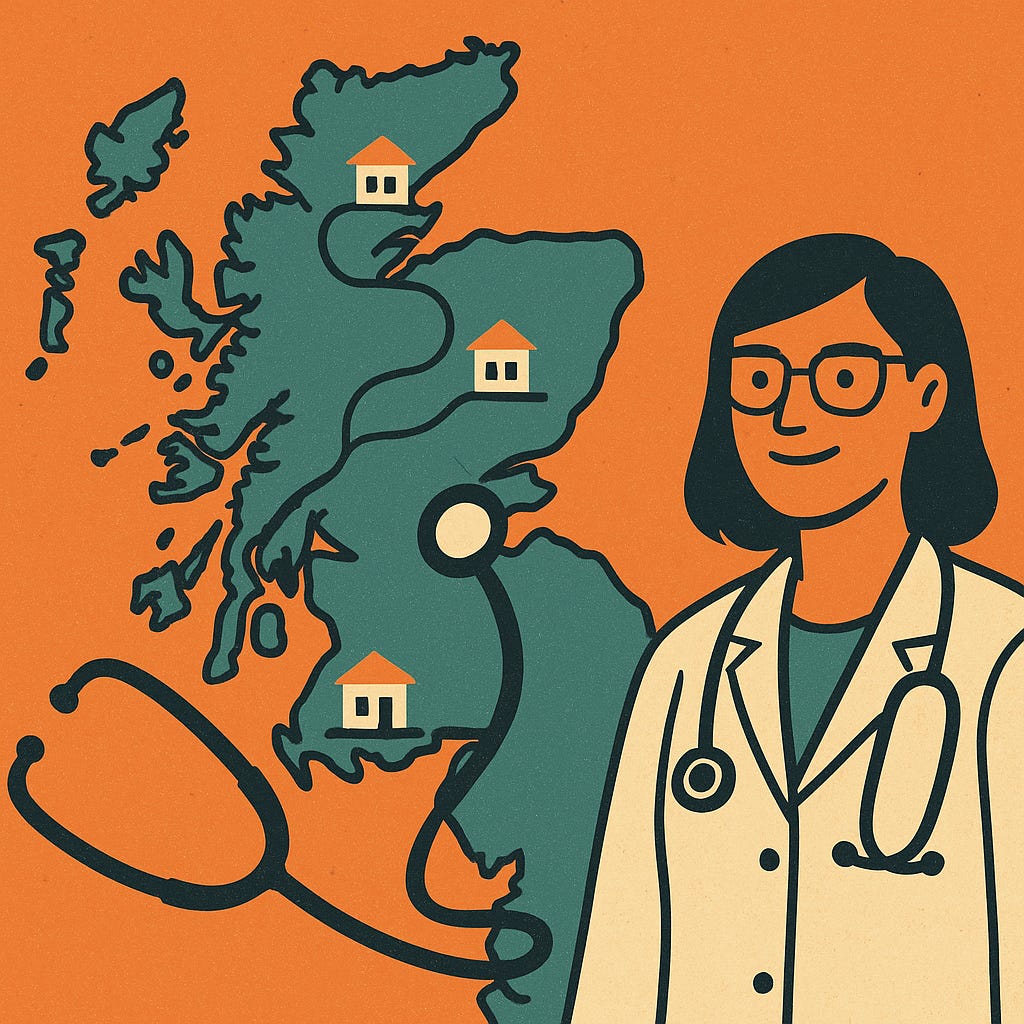
Scotland is facing an acute shortage of family doctors, felt most keenly in its Highlands and islands. In response, two universities and four health boards built a four-year graduate-entry course, Scottish Graduate Entry Medicine (ScotGEM), that sends students out to remote practices from year two, pairs them with salaried Generalist Clinical Mentors and asks them to run quality-improvement projects that matter to local communities. A new curriculum paper1 pulls back the curtain on how the programme works and what it has achieved so far.
What is ScotGEM?
Launched in 2018, ScotGEM compresses medical school into four graduate-entry years and distributes learning across four largely rural health boards. The paper details three pillars:
Generalist Clinical Mentors (GCMs) – part-time GPs hired to supervise the same six to eight students throughout the course, delivering up to forty per cent of contact time in years one and two.
Longitudinal Integrated Clerkship (LIC) – a full-year placement in a single general practice during year three, now spanning fifty-seven practices from Orkney to Dumfries.
Agents of Change strand – a spiral curriculum that trains students in service learning, informatics, public health, prescribing and quality improvement, each applied to real community projects.
Early outcomes
Surveys of recent cohorts show that eighty per cent plan to become GPs, eighty-three per cent intend to remain in Scotland and half aim for rural or remote posts, which are well above national averages. Foundation-programme data back this up: up to ninety per cent of graduates stay in Scotland for their first two postgraduate years. Meanwhile, the mentor scheme now injects an extra 4.2 full-time equivalent GPs into the NHS Fife workforce and involves seventy-eight educators statewide.
Why it matters
The paper provides a rare, granular blueprint for a socially accountable programme that is already shifting workforce intent. For educators elsewhere, ScotGEM demonstrates how graduate-entry students, longitudinal clerkships and paid local mentors can pull together to tackle regional shortages, so long as partners budget for travel stipends and invest in rural faculty development.
Conclusion
ScotGEM is more than a curriculum tweak; it is a systems intervention that recruits, trains and retains doctors where Scotland needs them most. If the early career-intention data translate into long-term practice patterns, the model offers a replicable route for other nations grappling with rural primary-care gaps—and a reminder that educational design can be powerful health-policy lever.
Read the paper full paper here, and remember to subscribe to this newsletter for future studies about how ScotGEM achieves it mission.